
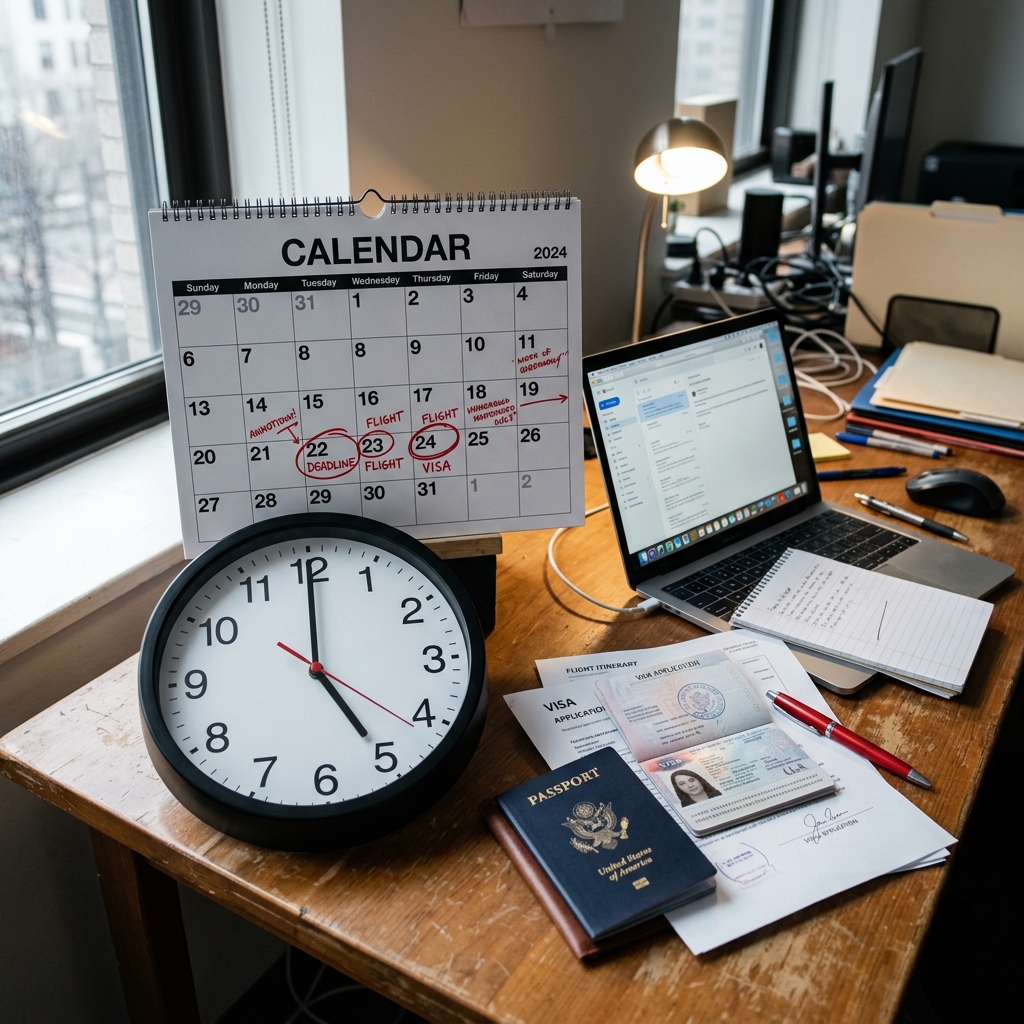
Why Last-Minute Applications Increase Refusal Risk
The temptation to delay visa applications until the last possible moment is remarkably common among UAE residents. The pressures of demanding professional schedules, the assumption that processing will be swift, and the optimistic belief that a strong financial profile can compensate for a compressed timeline combine to create a dangerous pattern of procrastination. In reality, last-minute visa applications submitted from the UAE carry a statistically elevated refusal rate that far exceeds applications submitted within the recommended timeframes. The reasons extend beyond simple processing capacity; they penetrate the fundamental mechanics of how consular officers assess credibility and intent.
When a consular officer opens a file and observes that the application was submitted mere days before the proposed departure, an immediate psychological flag is raised. The officer questions why an individual planning a legitimate, pre-arranged holiday or business trip waited until the final moment to secure travel authorization. This behavioral signal subtly undermines the narrative of a well-organized, genuine traveler and introduces doubt regarding the true nature and planning behind the proposed journey.
The Document Quality Deterioration
Time pressure invariably degrades the quality of submitted documentation. Applications assembled under urgency frequently contain misaligned dates, bank statements that are unnecessarily recent and therefore lack sufficient historical depth, and cover letters that read as hastily drafted afterthoughts rather than strategic narrative anchors. When an applicant has only three days to compile their file, the probability of a factual error on the application form, a missing signature, or an overlooked inconsistency between the employment letter and the bank statement increases dramatically. Each of these errors independently justifies a refusal, and under time pressure, they tend to compound.
Verification Becomes Impossible
Consulates routinely verify the authenticity of accommodation reservations, employment details, and financial claims by contacting third parties directly. These verification processes require time. When an application is submitted four days before departure, the consulate physically cannot complete its standard verification checks within the available window. In this scenario, the officer faces a binary choice: approve the application without completing due diligence, or refuse it based on the inability to verify claims. In risk-averse institutional cultures, the overwhelming default is refusal. The applicant has effectively removed the consulate's ability to do its job properly.
Priority and Expedited Services Are Not Guarantees
Many consulates offer priority or expedited processing for additional fees. Applicants frequently misinterpret these services as guaranteed fast-track approvals. In reality, expedited processing only accelerates the administrative timeline for reaching a decision. It does not alter the assessment criteria, lower the evidentiary threshold, or bypass security screening requirements. An application that would be refused under standard processing will be refused equally under expedited processing, only faster. The premium fee purchases speed of decision, not a favorable decision.
The Financial Snapshot Problem
Last-minute applications typically include bank statements covering the absolute minimum required period, often printed the day before submission. These compressed financial snapshots deprive the consular officer of the longitudinal view they need to assess genuine financial stability. A three-month statement printed on March 15th for a March 18th departure shows the officer a financial profile frozen at a single moment. Without the extended trajectory showing consistent salary credits, organic spending patterns, and sustained balance maintenance, the officer cannot distinguish between a genuinely stable applicant and someone who temporarily inflated their balance specifically for the application.
Insurance and Booking Fragility
Travel insurance policies purchased at the last minute frequently contain exclusions for pre-existing conditions or carry activation delays that technically leave the initial days of travel uncovered. Similarly, flight and accommodation bookings secured under time pressure are often the most expensive options available, creating a paradox where the applicant's bank balance must now justify premium costs that strain the proportionality test. An officer who sees a last-minute business class flight costing three months of the applicant's salary will question the economic rationality of the entire trip.
The Cascade Effect on Future Applications
A refusal resulting from a last-minute application carries the same permanent weight in global immigration databases as a refusal resulting from substantive inadequacy. The refusal letter does not distinguish between the two. Future consular officers reviewing subsequent applications will see a prior denial without context regarding the time pressure that caused it. The applicant must then spend months rehabilitating their profile to overcome a refusal that could have been entirely prevented by simply submitting the application three weeks earlier.
Optimal Submission Windows
For Schengen applications, the optimal submission window is four to six weeks before the intended departure. For UK applications, three to four weeks is advisable. For US B1/B2 applications, initiating the process two to three months in advance is prudent given the interview scheduling dynamics. These windows provide sufficient time for the consulate to process the application at a normal pace, conduct necessary verifications, and request supplementary documentation if needed without jeopardizing the travel dates. They also allow the applicant to compile a thorough, error-free file without the cognitive degradation imposed by urgency.
Strategic Planning as a Professional Practice
For UAE residents who travel internationally on a regular basis, visa application timing should be treated as a structured professional practice rather than a reactive chore. Maintaining an always-current file of core documents, including employment letters, bank statements, and passport copies, reduces the preparation burden when a new trip materializes. Tracking passport validity and ensuring renewal occurs well before the six-month minimum threshold prevents the most common logistical bottleneck. Treating the visa process with the same disciplined planning applied to professional deliverables consistently yields superior outcomes.
How Patriot Pro Travel & Tourism Approaches Applications
Risk assessment: We conduct a thorough audit of your profile to identify vulnerabilities before they reach a consular officer.
Profile positioning: We ensure your professional standing and financial footprint are presented in the most compelling light possible.
Document alignment: We cross-verify every certificate, statement, and itinerary to eliminate contradictions that trigger refusals.
Strategy planning: We guide you on the optimal embassy, timeline, and approach tailored to your specific circumstances.
Reducing refusals: By preemptively addressing common consular concerns, we systematically lower the probability of rejection.
Our methodology is built on precision, deep consular insight, and an unwavering commitment to our clients' global mobility. We handle the complexity so you can travel with confidence.