
The EU Entry/Exit System: What Changed at Schengen Borders for UAE Travellers
The clearest sign that something has changed arrives after the queue, not during it. The officer photographs you, asks for your fingertips, hands the passport back, and there is no stamp in it. For travellers who spent years counting inked squares to work out how much of Europe they had left, that blank page is the story.
What the EES Is and Where It Applies
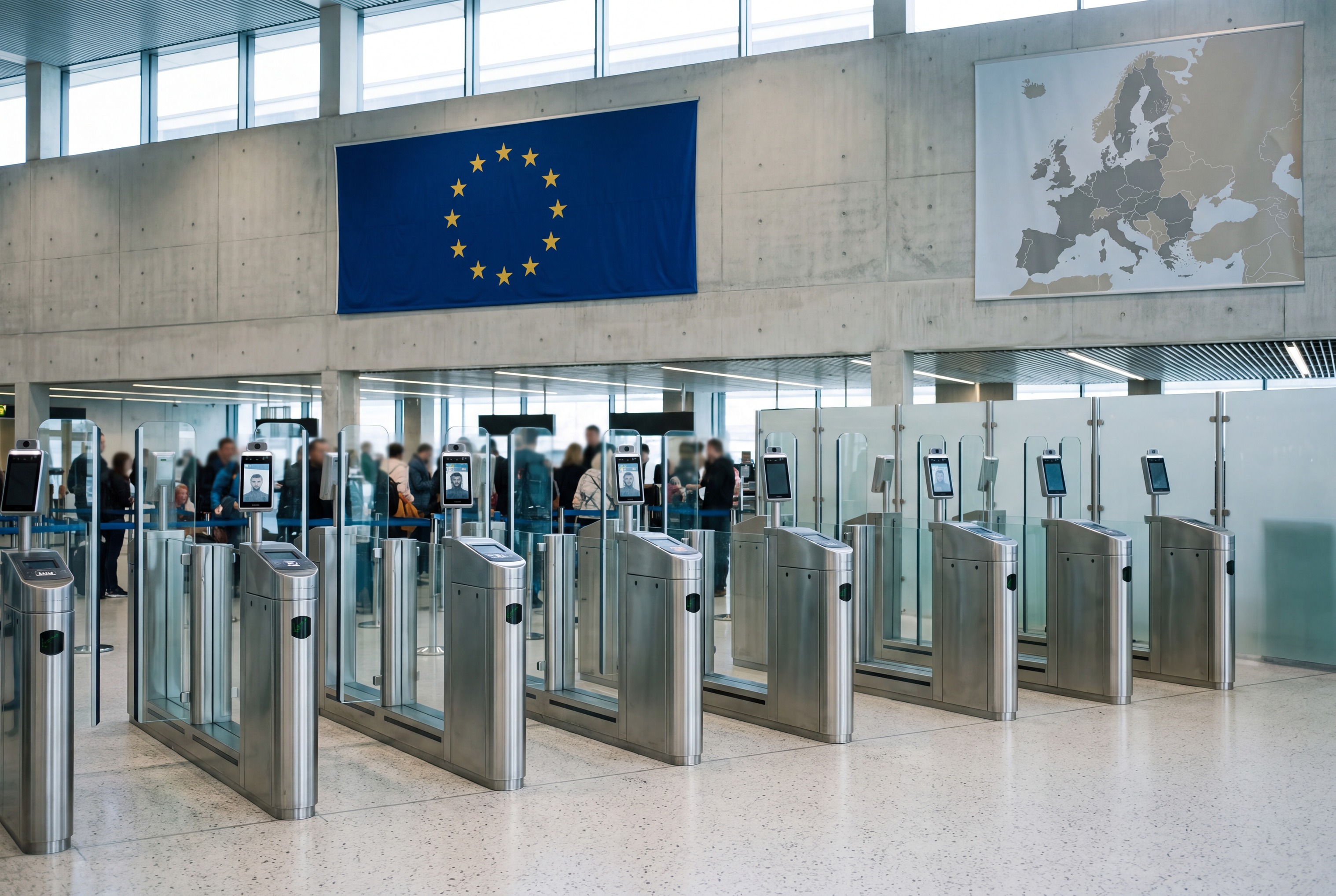
The Entry/Exit System is an automated register that records non-EU nationals each time they cross an external border for a short stay. It began operating progressively on 12 October 2025 and became fully operational on 10 April 2026, replacing the manual stamping of passports. The facts here were checked against European Commission and EU legislative sources on 26 July 2026.
It runs at the external borders of the 29 countries that make up the Schengen Area: 25 EU member states plus Iceland, Norway, Switzerland and Liechtenstein. Older travel writing often says 27, which is the size of the European Union, not the Schengen Area. What gets recorded is narrow: your name and travel document details, a facial image, fingerprints, and the date and place of every entry and exit, plus any refusal of entry. There is nothing to submit in advance, no fee and no form.
Your Passport Decides the Rules, Not Your Emirates ID
This is where confusion starts in the UAE, where one family walking through Dubai International can be carrying three different passports. Residence here confers no European entry right. What decides how a Schengen border treats you is the passport you hand over.
Emirati nationals travel to the Schengen Area without a short-stay visa under the reciprocal EU-UAE visa waiver agreement published in the Official Journal in May 2015, covering stays of up to 90 days in any 180-day period. Holders of most other passports living here, including Indian, Pakistani, Filipino, Egyptian and Bangladeshi nationals, still need a Schengen visa issued before departure. The Entry/Exit System changes nothing about that; it is a border record, not an entry permission. If you are working out which route applies in your household, the page on what a Schengen visa application from the UAE involves sets out what consulates ask for. Both groups are then registered identically at the border; the difference is what each had to do beforehand.
The First Crossing, and Every Crossing After It
On your first entry or exit after the system applies to you, a full individual file is created. A border officer, or a self-service kiosk at airports that have installed them, captures your passport data, a facial image and your fingerprints. Children under 12 are photographed but are not asked for fingerprints.
Later crossings are lighter. Your fingerprints or facial image are checked against the file that already exists, which is verification rather than fresh enrolment, and the record is normally kept for around three years after your last exit. Exits are captured as well as entries, and that second half is the one travellers forget; it is what proves you left on time.
In practice, the first trip after registration is the slow one. Departures from Dubai, Abu Dhabi and Sharjah into the busier European hubs have met longer arrival queues since the system came in, and the phased rollout allowed border authorities limited scope to ease processing at a crossing point in exceptional circumstances. That is a tool for them, not something a passenger can plan around. Give your first onward connection in Europe more margin than you once would have.
The 90/180 Count Is Now Calculated For You
Under the stamp system the limit was policed by arithmetic, some of it yours and some done quickly at a desk. Because every entry and exit is now timestamped in one database, the remaining authorised stay is computed automatically and overstays are detected without anyone counting stamps. The limit itself is unchanged: a maximum of 90 days within any rolling 180-day period, counted backwards from the day in question rather than reset each January. What has changed is that a miscalculation shows up immediately, at every border. The EU publishes a free tool on its official travel site, travel-europe.europa.eu, for checking how much authorised stay remains before you commit to dates.
Who Is Not Registered
The system covers short stays by non-EU nationals. Several groups fall outside it.
Nationals of EU, EEA and Swiss countries, and family members travelling under EU free-movement rights.
Third-country nationals holding a valid residence permit for a participating country, who are residents rather than short-stay visitors.
Holders of a long-stay national visa, the type D category, for a participating country.
Nationals of Andorra, Monaco, San Marino and the Holy See.
Someone holding both a UAE residence visa and a European residence permit should present the European permit at the border, so they are processed as a resident rather than enrolled as a visitor on a 90-day clock that does not apply to them. Where a status sits between categories, confirm it before departure rather than at the desk; that kind of pre-travel review is part of what the travel and visa services offered from the UAE are built around.
Planning Around It From the UAE
For visa-required passports the sequence matters more than the biometrics. The EES has not shortened any consular stage, and appointment availability rather than the border system usually sets the earliest realistic departure date, so arranging a visa appointment early remains the most useful thing to get right. Keep boarding passes and exit records from previous trips until the next one is done, particularly if you left by land or sea.
ETIAS: Still Not Live, and Nothing to Apply For
The other half of the EU's border package is the European Travel Information and Authorisation System, or ETIAS: a separate pre-travel authorisation that visa-exempt nationals, Emirati passport holders among them, will eventually obtain online before flying. It is not operating.
As of 26 July 2026, the European Commission states that ETIAS is not in operation, that no applications are being collected, and that the EU will announce the start date several months before launch. No firm start date has been published. You therefore cannot apply, and no intermediary can apply for you. When it does open, the official channel will sit on the europa.eu domain.
Frequently Asked Questions
Does the Entry/Exit System replace my Schengen visa?
No. If your passport nationality requires a Schengen visa, you still apply through the responsible consulate or its authorised visa centre before you travel. The EES records your crossing once you arrive; it does not authorise it.
I hold a UAE residence visa. Does that exempt me from registration?
No. The exemption covers residence permits issued by a country inside the Schengen Area, not UAE residence. Your Emirates ID has no standing at a European border, though it is commonly requested at the visa application stage.
My passport was renewed after my last trip to Europe. What happens now?
Your record is linked to the travel document as well as to you, so a new passport means the border check takes longer while the file is updated. Carry the previous passport if you still hold it.
What happens if the system shows I overstayed by a few days?
Automatic detection of overstays is one reason the system exists, and a recorded overstay can affect a future entry decision or visa application. Those consequences are decided by border and consular authorities case by case, not by any agency. Check your remaining days before booking.
How Patriot Pro Travel & Tourism Helps
The Entry/Exit System changed the record-keeping at the border, not the preparation that gets a traveller there, and for most UAE residents the consular stage is still where a European trip is made or delayed.
Reviewing passport nationality, UAE residence status and travel history to establish which route to Europe applies.
Checking that passports, photographs, insurance cover and supporting documents match what the responsible consulate asks for.
Advising on the right short-stay category for the purpose of travel rather than defaulting to a general tourist application.
Pointing out avoidable errors, including inconsistent name spellings across passport, Emirates ID and booking confirmations.
Helping assemble a complete, consistent file so it can be assessed without repeated requests for missing paperwork.
Working backwards from appointment availability so flights and accommodation follow a realistic timeline.
Decisions at the consulate and the border belong to the authorities alone. What can be controlled is whether an application gives them reason to hesitate. For UAE residents and Emirati nationals preparing a European trip under the new border rules, the Schengen visa guidance from Patriot Pro Travel & Tourism is the place to start.