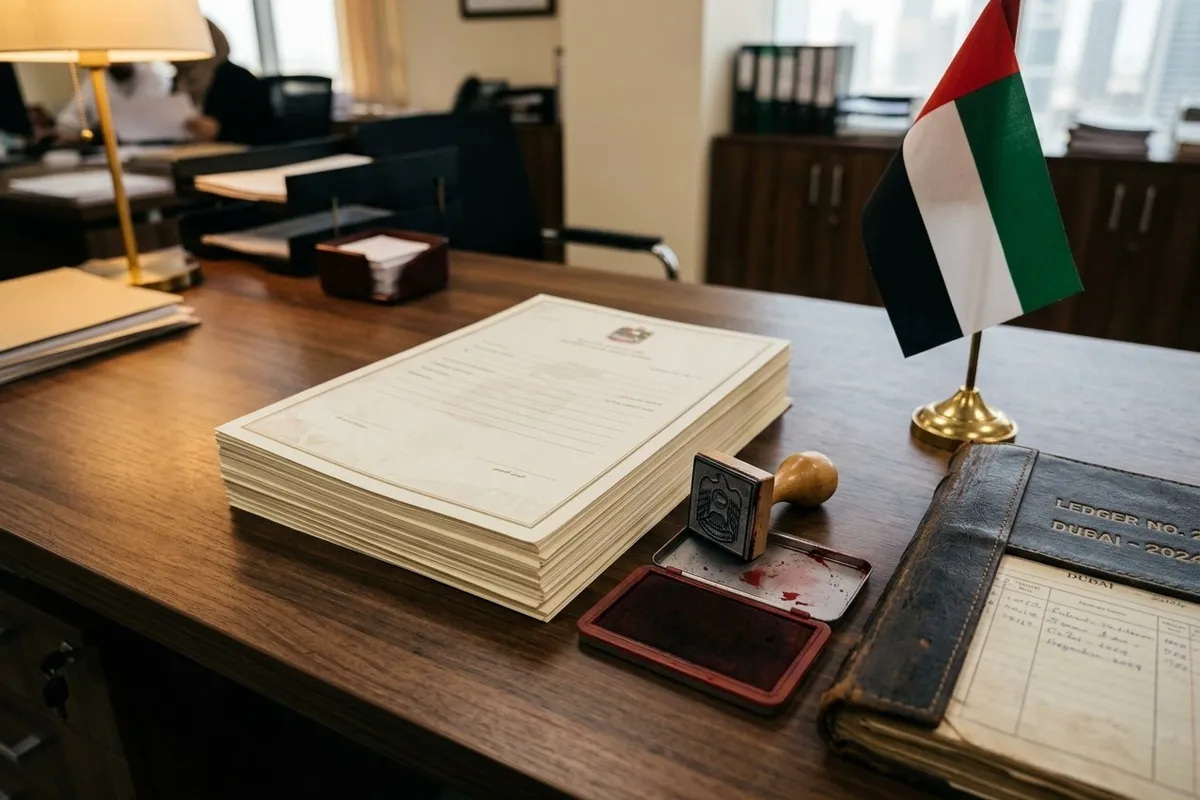
Document Attestation and Translation in the UAE: What Consulates Accept
Document Attestation and Translation in the UAE: What Consulates Accept
A marriage certificate issued in Manila, a degree from Hyderabad, a birth certificate from Cairo. Every UAE resident has a small stack of documents issued somewhere else, and sooner or later one of them has to be produced for something official. That is the point at which people discover that a document being genuine and a document being usable are two different conditions.
Attestation is what closes the gap, and it has an order to it. Doing the steps out of sequence is the most common and most expensive mistake, because a step performed too early usually has to be performed again.
What Attestation Actually Certifies
Attestation certifies the authenticity of signatures and seals on a document. It is not a statement that the contents are true, and it is not a translation. It confirms that the official who signed held the office, and that the seal is the seal it appears to be.
Understanding that narrow purpose explains the whole chain. Each authority in the sequence attests the signature of the authority before it, which is why the order cannot be rearranged.
Requirements here were checked against the UAE Ministry of Foreign Affairs on 28 August 2026. Procedures and fees change, so confirm the current position on the Ministry's portal before starting.
The Order for a Document Issued Outside the UAE
This is the sequence that matters to most residents, because most of the documents in question were issued before they arrived.
- The document is attested by the Ministry of Foreign Affairs of the country that issued it.
- It is then attested by the UAE Embassy or Consulate in that country.
- It is then submitted to the UAE Ministry of Foreign Affairs, through the Ministry's portal, where you register, select attestation through UAE missions abroad, complete the information and pay the fees. You receive a confirmation with an application reference number.
Check whether the UAE mission in the relevant country offers the service electronically. Where it does not, attendance in person is required, and where there is no UAE mission in that country at all, the Ministry directs applicants to contact it through its contact centre.
The step people skip is the first one. A document carried to the UAE and presented directly to the Ministry here cannot be attested, because the chain has no starting link. Non-local documents must be attested by the UAE Embassy or Consulate in their relevant country, and a mission will not legalise another country's paperwork.
Language, and Why Translation Is Its Own Document
The Ministry requires the document to be in Arabic or English, or accompanied by a legally certified translation, with the original certified or attested by the relevant competent authorities where applicable.
Where the source language is neither Arabic nor English, the translation carries its own chain. UAE missions describe a sequence involving translation of the original by an authorised court interpreter into English or Arabic, verification of both the original and the translation by the competent court, and then certification by the Ministry of Justice.
The consequence to plan for: the original and the translation are treated as separate documents, and each requires its own stamp and its own fee. A resident budgeting for one attestation and arriving with two documents has underestimated the cost by roughly half.
Note also what the Ministry does not do. It does not translate. Arranging a legally certified translation is your task, completed before submission, not a service performed at the counter.
The Practical Rules That Cause Rejections
- Documents must not be laminated or thermally sealed. Laminating a certificate to protect it is the single most self-defeating thing a person can do to it.
- Official personal documents such as marriage, birth and death certificates must be submitted in original form. Other documents may be originals or true copies, provided they are legalised by the respective foreign office.
- Documents apostilled in a bundle are not accepted. Each must be apostilled separately.
- There is no expiry date on an attested document, which is worth knowing before paying to redo one that is simply old.
The Other Direction, Which Also Comes Up
The Ministry attests documents issued within the UAE as well as those issued outside it, and residents need that far more often than they expect. A UAE marriage certificate presented to a foreign consulate, an Emirates-issued birth certificate for a child born here, a UAE employment or salary document required abroad: each of these is the mirror image of the process above.
The chain runs the same way, in reverse. The document is first certified by whichever UAE authority issued or is competent for it, then attested by the Ministry of Foreign Affairs here, then, where the destination country requires it, legalised by that country's mission in the UAE.
The practical consequence for a family is that a household can easily have documents moving in both directions at once, on different timelines, for the same application. A child born in Dubai to parents married abroad has a birth certificate that needs the outward chain and a parental marriage certificate that needs the inward one. Mapping which document needs which route, before starting either, saves the most time of anything in this article.
Digital Attestation
The Ministry operates a digital attestation service available through various UAE embassies worldwide and applicable to documents issued outside the UAE. Attestations are typically completed within two to three working days, and the resulting documents are legally recognised within the UAE.
One detail prevents a wasted assumption: the physical document is still required in order to issue the digital attestation. Digital describes the output and the process, not the absence of paper.
How This Connects to a Visa Application
Not every document in a visa file needs attestation. Bank statements, employment letters and hotel bookings generally do not. What tends to need it is the category of civil-status and educational documents used to prove a relationship or a qualification: marriage certificates supporting a spouse's application, birth certificates establishing parentage for a child, degree certificates for certain purposes.
Consulates set their own requirements, and they differ. Some accept a translation by a legal translator without a full attestation chain; others require the document legalised end to end. The rule that saves time is to read the specific checklist for the specific application before starting a process that takes weeks, rather than attesting everything defensively.
Timing is the other planning point. An attestation chain that crosses two countries is not a task for the fortnight before an appointment. Where a trip depends on a document issued abroad, that document is the long pole and should be started first.
Questions UAE Residents Ask
Can I get a document attested in the UAE if it was issued in my home country?
Not as a starting point. It must first be attested by the issuing country's foreign ministry and then by the UAE mission in that country before the UAE Ministry of Foreign Affairs stage.
Does the Ministry provide translation?
No. Documents must be in Arabic or English or accompanied by a legally certified translation, which you arrange. Where the source language is another, the translation typically needs court and Ministry of Justice certification in the issuing country.
Do I pay twice if my document is translated?
The original and the translation are treated as separate documents, each requiring its own stamp and fee.
My certificate is ten years old. Does it need redoing?
There is no expiry date on an attested document. Whether a particular consulate wants a recently issued certificate is a separate question set by that consulate.
How Patriot Pro Travel & Tourism Helps
Attestation is not complicated so much as strictly ordered, and the cost of learning the order by trial is measured in weeks and repeated fees.
- Identifying which documents in your file genuinely need attestation and which do not.
- Setting out the correct order of steps for the country that issued each document.
- Flagging where a certified translation is required and what chain that translation has to follow.
- Checking documents for the practical faults that cause rejection, including lamination and bundled apostilles.
- Planning the timeline so a document crossing two countries is started first rather than last.
- Reading the specific consulate checklist so nothing is attested unnecessarily.
If a visa application in your household depends on a certificate issued somewhere else, the sensible time to look at it is now rather than after the appointment is booked. Our visa and travel services cover document preparation for UAE residents, and if you want a specific document assessed before you spend anything on it, get in touch.